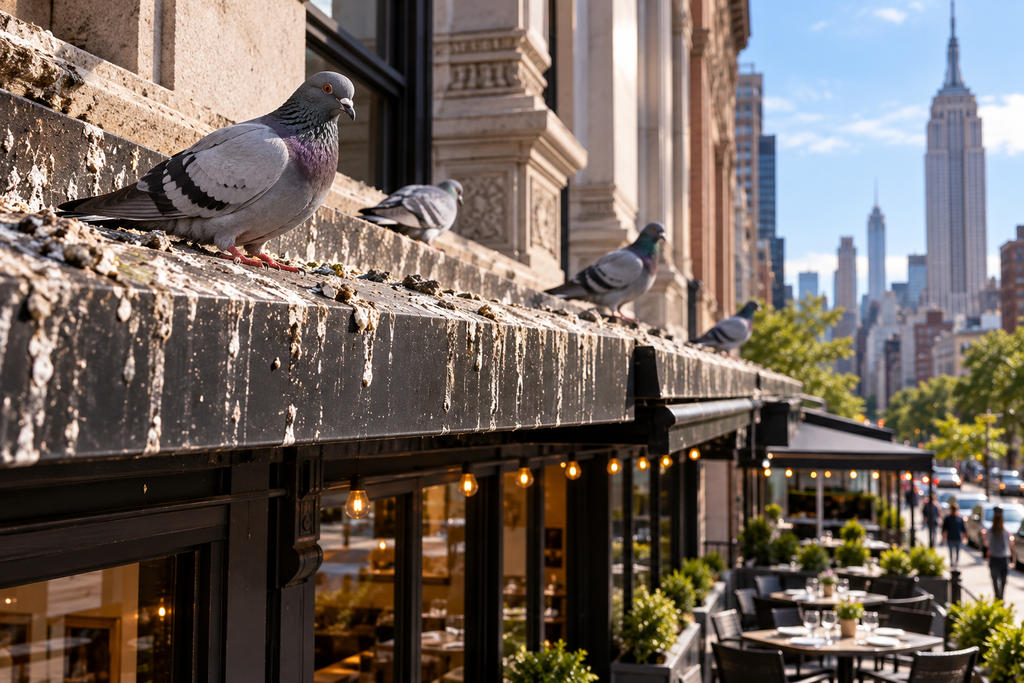
For New York City restaurant owners, facility managers, and commercial building operators, pigeons are more than just a nuisance—they are a direct threat to your bottom line. If you are constantly paying for power-washing services to clean up pigeon guano off your sidewalks, loading docks, or outdoor dining patios, you are fighting a losing battle.
Worse, accumulated pigeon droppings are a fast track to New York City Department of Health (DOH) violations, failed inspections, and costly fines. To protect your property and remain compliant, temporary deterrents aren’t enough. You need permanent pigeon exclusion.
The Hidden Costs of Pigeon Droppings for NYC Businesses
Pigeon droppings (guano) are highly acidic. When left untreated on building facades, awnings, and HVAC units, they eat through paint, degrade roofing materials, and permanently stain stone and brickwork. However, the financial damage goes far beyond aesthetics:
- DOH Fines and Closures: The NYC DOH considers bird droppings a severe sanitary hazard, particularly for food service establishments. Accumulation near entrances, ventilation intakes, or outdoor seating can result in immediate citations.
- Slip-and-Fall Liabilities: Wet pigeon droppings are incredibly slippery, creating significant liability risks on commercial walkways, fire escapes, and entryways.
- Health and Safety Risks: Guano harbors dangerous fungal spores and bacteria, including Histoplasmosis and Cryptococcosis. When droppings dry out and become airborne, they can be pulled into a building’s HVAC system, jeopardizing indoor air quality for tenants and customers.
Why Temporary Bird Deterrents Fail
Many property managers waste thousands of dollars on ineffective, off-the-shelf bird control methods. Fake owls, ultrasonic noise emitters, and poorly installed plastic spikes rarely work long-term. NYC pigeons are highly habituated to urban environments; they quickly realize these deterrents pose no actual threat and will simply build their nests directly on top of cheap spikes.
The Permanent Solution: Professional Bird Exclusion
To permanently get rid of pigeons in NYC, commercial properties must rely on physical exclusion. By completely sealing off the architectural features that pigeons use for roosting and nesting, you force the flock to relocate entirely.
The most effective, permanent bird control methods include:
- Commercial Bird Netting: The gold standard for permanent exclusion. Heavy-duty, UV-resistant netting completely blocks access to recessed areas, HVAC enclosures, loading docks, and courtyards. When installed professionally, it is virtually invisible from the ground.
- Low-Profile Shock Track Systems: For parapet walls, signs, and roof edges where netting isn’t viable, electrified shock tracks offer a highly effective solution. They deliver a harmless but startling static pulse that conditions the birds to avoid the ledge, all while remaining completely out of sight.
- Professional Structural Modification: Sealing gaps, modifying ledge angles, and permanently closing access to soffits and crawlspaces to eliminate nesting habitats.
Frequently Asked Questions About NYC Pigeon Removal (FAQ)
How do you permanently get rid of pigeons in NYC? The only way to permanently remove pigeons from a commercial property is through physical exclusion. This involves installing professional-grade bird netting, stainless steel spikes, or electrified shock tracks that physically prevent birds from landing, roosting, or nesting on the structure.
Can pigeon droppings cause a failed health inspection in New York? Yes. The NYC Department of Health (DOH) strictly regulates sanitary conditions. Accumulations of pigeon droppings near food preparation areas, outdoor dining spaces, or building entrances are considered a health code violation and can result in severe fines or failed inspections.
Is cleaning up pigeon droppings dangerous? Yes. Dry pigeon droppings can release fungal spores into the air, which can cause respiratory diseases like Histoplasmosis. Professional sanitization using specialized protective equipment and biocides is required before installing exclusion devices.
Stop the Fines and Protect Your Property
Stop throwing money away on endless cleanups and temporary fixes. If you are dealing with persistent pigeon problems at your commercial facility or restaurant, it is time to implement a zero-tolerance exclusion strategy.
Contact Systematic Pest Elimination today for a comprehensive site evaluation. We specialize in designing and installing customized, permanent bird control systems that keep your property clean, safe, and fully compliant with NYC health regulations.